Check engine light codes: what P0420, P0171 and P0300 mean, and how to read them yourself (OBD2 adapter or Arduino)
How OBD2 trouble codes are built, the ten codes drivers search most, when a warning light means stop now, and three ways to read the code yourself: a cheap Bluetooth adapter, a phone app, or a DIY Arduino CAN reader.
A recent video of a hobbyist reading a 1994 Jeep's engine computer with a $3 Arduino and AI coding tools got thousands of people asking the same question: can I read my own car's fault codes instead of paying for a diagnosis? For most cars, yes. Here is what the codes mean, how to read them, and where to stop.
1. First: is it safe to keep driving?
- Flashing engine light: usually a severe misfire. Unburned fuel can overheat the catalytic converter. Slow down and stop somewhere safe.
- Red oil-pressure or temperature light: stop and turn the engine off. These are not "check later" lights.
- Steady amber engine light with a car that drives normally: you can usually drive to a garage, but read the code soon. First check that the fuel cap is tight.
2. How to read a code like P0420
- First letter: P = powertrain (engine, gearbox), B = body, C = chassis (ABS, brakes), U = network between control units.
- First digit: 0 = standard code with the same meaning on every car, 1 = the manufacturer's own meaning.
- Second digit: the system, for example 1–2 fuel and air, 3 ignition and misfire, 4 emissions, 5 speed and idle, 7–9 transmission.
3. The codes drivers search most
| Code | Meaning | Common causes |
|---|---|---|
| P0420 | Catalyst efficiency below threshold (bank 1) | Worn catalytic converter, faulty rear oxygen sensor, exhaust leak |
| P0171 / P0174 | System too lean | Vacuum leak, dirty mass air flow sensor, weak fuel pump |
| P0300 | Random or multiple cylinder misfire | Spark plugs, ignition coils, injectors, vacuum leak |
| P0301–P0306 | Misfire in cylinder 1–6 | Swap the coil with another cylinder: if the code moves, it is the coil |
| P0128 | Coolant below thermostat temperature | Thermostat stuck open |
| P0442 / P0455 / P0456 | Evaporative system leak | Loose or worn fuel cap, cracked hose, purge valve |
| P0401 | EGR flow insufficient | Carbon in the EGR valve or passages |
| P0135 / P0141 | Oxygen sensor heater circuit | Old oxygen sensor, wiring |
| P0700 | Transmission control system fault | Read the transmission unit for the detailed code |
| U0100 | Lost communication with engine control unit | Weak battery, connector, wiring |
A code tells you which test failed, not which part is broken. P0420 is often replaced with a new catalytic converter when the real problem was a $40 sensor or an exhaust leak.
4. Three ways to read it yourself
Almost every petrol car sold in the US since 1996 and in the EU since 2001 (diesel 2004) has a standard 16-pin OBD2 port under the dashboard, usually near the steering column. Cars older than that, like the 1994 Jeep in the video, use maker-specific systems, which is why that one needed reverse engineering.
- Handheld code reader. Plug in, read, done. No phone needed.
- Bluetooth or Wi-Fi OBD2 adapter + phone app. Shows codes, freeze-frame data and live values (RPM, coolant temperature, fuel trims). Very cheap clone adapters sometimes drop the connection or do not support every protocol.
- DIY Arduino or ESP32. A CAN transceiver module (MCP2515 or similar) on pins 6 (CAN-H) and 14 (CAN-L), ground on pins 4–5, and the board can send standard OBD2 requests: mode 03 returns stored codes, mode 01 returns live values such as RPM (PID 0C) and coolant temperature (PID 05). Libraries exist for both CAN and ELM327-style adapters. Older cars use the K-line (pin 7) instead of CAN.
5. Where to stop
- Read, don't write. Reading codes and live data is harmless. Writing to the engine computer (flashing, remapping) can leave a car that will not start.
- Don't clear codes before the repair. Clearing also resets the readiness monitors, and an inspection can fail until the car has driven enough to complete them.
- Disabling emission controls (catalyst, EGR, particulate filter) is illegal on public roads in most countries.
- Airbag (B) and ABS (C) faults are safety systems: leave the repair to a garage.
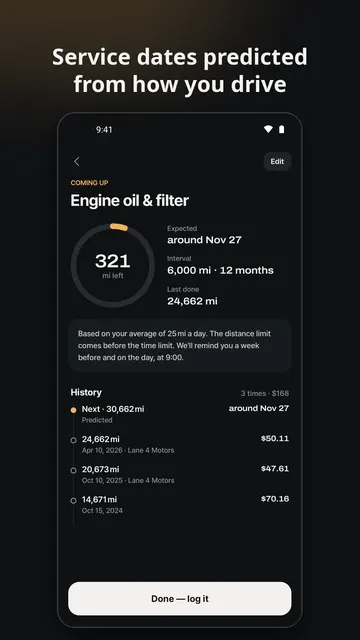
Keep the code with the repair
Dashlamp does not read codes from the car; for that you need an adapter and a scanner app, or your own Arduino. What Dashlamp does is keep the story: write the code, the date, the mileage and what the garage did in a service record, attach the receipt photo, and set a reminder to check again. Next time the same code comes back, you can see when it last appeared and what fixed it. Everything stays offline on your phone.