Protein intake calculator: how many grams per kg do you need?
Work out daily protein from your body weight (0.8 to 2.0 g/kg) for weight loss, strength training and over 65, how to split it across meals, and who should be careful with high protein.
Some say more protein is always better; others warn it strains your kidneys. The simplest way to find your own number is grams per kilogram of body weight. Multiply by your weight and you have a daily target.
1. Protein per kg: a quick table
| Situation | Per kg of body weight | At 70 kg (154 lb) |
|---|---|---|
| Minimum for most healthy adults | 0.8 g | about 56 g |
| Losing weight, light exercise | 1.2 g | about 84 g |
| Losing weight while keeping muscle | 1.6 g | about 112 g |
| Regular strength training | 1.6 to 2.0 g | 112 to 140 g |
| Age 65 and over | 1.0 to 1.2 g | 70 to 84 g |
0.8 g/kg is the adult minimum used by the WHO and the US Recommended Dietary Allowance. For people who exercise, the International Society of Sports Nutrition suggests 1.4 to 2.0 g/kg a day. When you cut calories, muscle tends to go with the fat, so many studies on weight loss use about 1.2 to 1.6 g/kg.
2. How to calculate it
- Daily protein (g) = weight (kg) × target (g/kg). In pounds, divide your weight by 2.2 first. Example: 70 kg aiming to keep muscle while losing weight: 70 × 1.6 = 112 g.
- With a lot of excess weight, using current weight can give a very large number. Use your goal weight instead, or check that protein stays around 10 to 35% of your calories.
- One gram of protein is about 4 kcal. 112 g is about 450 kcal, roughly a quarter of an 1,800 kcal day.
3. Spread it across meals
Research suggests 20 to 40 g at each of three meals works better for muscle than one large protein dinner. If breakfast is just toast and coffee, adding eggs, milk or soy milk, or Greek yogurt makes a big difference.
4. Protein in everyday foods (approximate)
- Chicken breast, cooked, 100 g: about 30 g
- One large egg: about 6 g
- Canned tuna, 100 g: about 20 to 25 g
- Firm tofu, 150 g: about 12 to 15 g
- Milk, 250 ml: about 8 g · Greek yogurt, 100 g: about 9 to 10 g
- Lentils, cooked, 1 cup: about 18 g
Products and recipes vary, so check the nutrition label.
5. Too much protein: who should be careful
- Up to about 2 g/kg is generally considered fine for healthy adults, but going higher brings little extra benefit for most people.
- People with chronic kidney disease may need to limit protein. If you have diabetes or gout, or are pregnant or breastfeeding, talk to your doctor or dietitian before setting a target.
- Adding shakes while cutting vegetables and whole grains can leave you short on fibre. Drink enough water.
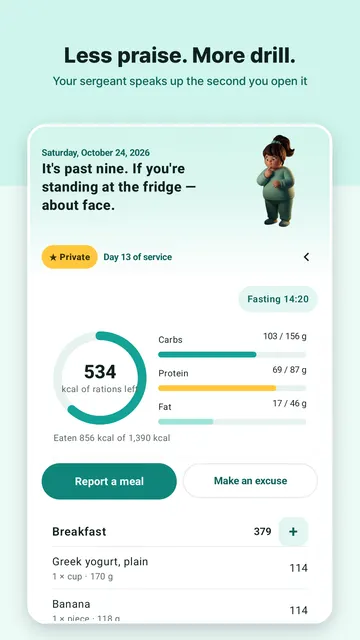
Hitting your protein number with DietSarge
DietSarge is a calorie and food log with no account. Add what you ate by search, photo or a short sentence, and the Today screen shows your calories and how many grams of protein are left to your target. Public nutrition databases (USDA, Korea, Japan) are built in, and foods you eat often can be added again in one tap. The app does not replace advice from your doctor or dietitian.
New in DietSarge 2.7: the Body calculator on the Trend tab now has a protein section. Enter your weight to see grams per day at 0.8, 1.2, 1.6 and 2.0 g/kg, then tap [Use] to make it your Today protein target (kept between 10% and 40% of your calories, with carbs and fat sharing the rest). You can also change it under Settings > Protein target.