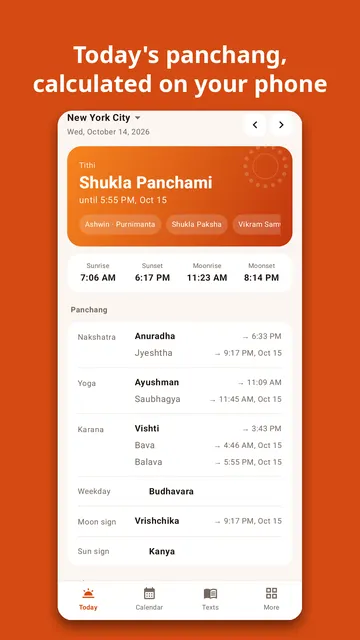
How to read today's panchang: tithi, nakshatra, Rahu Kalam and muhurat times
The five parts of a Hindu panchang, why Rahu Kalam, Dur Muhurtam and Abhijit change from city to city, and how Varjyam, Amrit Kalam and Panchak are worked out, in plain English.
Every morning millions of people look up "panchang today" or "Rahu Kaal today". A panchang mixes two kinds of information: things that are the same everywhere on that day (tithi, nakshatra, yoga) and things that depend on your city's sunrise and sunset (Rahu Kalam and the muhurat times). Once you see the difference, any panchang becomes easy to read.
Example: Monday, 16 November 2026
The tithi is Shukla Saptami until 04:20 on 17 November, then Ashtami. The nakshatra is Shravana until 02:17 on 17 November. Those times are the same across India. The times below depend on the city (Indian Standard Time, Lahiri ayanamsa):
| City | Sunrise | Sunset | Rahu Kalam | Dur Muhurtam |
|---|---|---|---|---|
| Delhi | 06:44 | 17:27 | 08:04 – 09:24 | 12:27 – 13:09, 14:35 – 15:18 |
| Mumbai | 06:46 | 17:59 | 08:10 – 09:34 | 12:45 – 13:30, 15:00 – 15:45 |
| Lucknow | 06:26 | 17:15 | 07:47 – 09:08 | 12:12 – 12:55, 14:22 – 15:05 |
| Kolkata | 05:49 | 16:52 | 07:12 – 08:35 | 11:43 – 12:27, 13:55 – 14:40 |
| Bengaluru | 06:18 | 17:50 | 07:44 – 09:11 | 12:27 – 13:13, 14:45 – 15:31 |
| Chennai | 06:07 | 17:39 | 07:34 – 09:00 | 12:16 – 13:02, 14:34 – 15:20 |
Amrit Kalam today is 14:40 to 16:27. It comes from the nakshatra, so it is the same moment in every city.
1. The five limbs (pancha anga)
- Tithi: the angle between the Moon and the Sun, one tithi for every 12 degrees. Fasts and festivals follow the tithi.
- Nakshatra: which of the 27 lunar mansions the Moon is in.
- Yoga and karana: two more limbs from the Sun and Moon positions. The karana called Vishti is also known as Bhadra.
- Vara: the weekday. A Hindu day runs from sunrise to the next sunrise, not from midnight.
2. Why Rahu Kalam is different in every city
The daytime from sunrise to sunset is split into eight equal parts. Rahu Kalam is one of those parts, chosen by the weekday: the 2nd on Monday, 3rd on Saturday, 4th on Friday, 5th on Wednesday, 6th on Thursday, 7th on Tuesday and 8th on Sunday. In winter, with short days, it lasts about 80 minutes; in summer it can be over 100. Yamaganda and Gulika Kalam are found the same way. That is why "Rahu Kaal Delhi" and "Rahu Kaal Mumbai" give different answers.
3. Dur Muhurtam, Varjyam, Amrit Kalam, Abhijit and Panchak
- Dur Muhurtam: the day is split into 15 muhurtas. Depending on the weekday, one or two of them are Dur Muhurtam (on Monday the 9th and 12th; on Tuesday the 4th and the 7th muhurta of the night).
- Varjyam: about four ghatis (roughly an hour and a half) starting at a fixed point inside each nakshatra.
- Amrit Kalam: worked out the same way from the nakshatra, but considered favourable.
- Abhijit Muhurat: the 8th muhurta of the day, around local noon. Traditionally it is not used on Wednesday.
- Panchak: the roughly five days when the Moon is in Aquarius and Pisces (Kumbha and Meena), from the second half of Dhanishtha to the end of Revati.
Good and bad times are a matter of tradition and belief. For big events such as a wedding or griha pravesh, ask your family priest or astrologer to choose the muhurat.
4. Why two panchangs can differ by a minute
The definition of sunrise (upper edge or centre of the Sun), the ayanamsa (Lahiri, Raman, KP) and the city coordinates can each move a time by a minute or two. North India counts months as purnimanta and much of the south and west as amanta, so the month name can also differ. Tithi and nakshatra end times agree closely in any careful panchang.
Today's panchang in the Online Mandir app
Online Mandir calculates the panchang for your city on your phone, offline: tithi, nakshatra, yoga, karana, sunrise and sunset, Rahu Kalam, Yamaganda, Gulika, Abhijit, Brahma Muhurta and Choghadiya, plus reminders for festivals and Ekadashi. It also has a small 3D mandir where you can light a diya and do aarti.